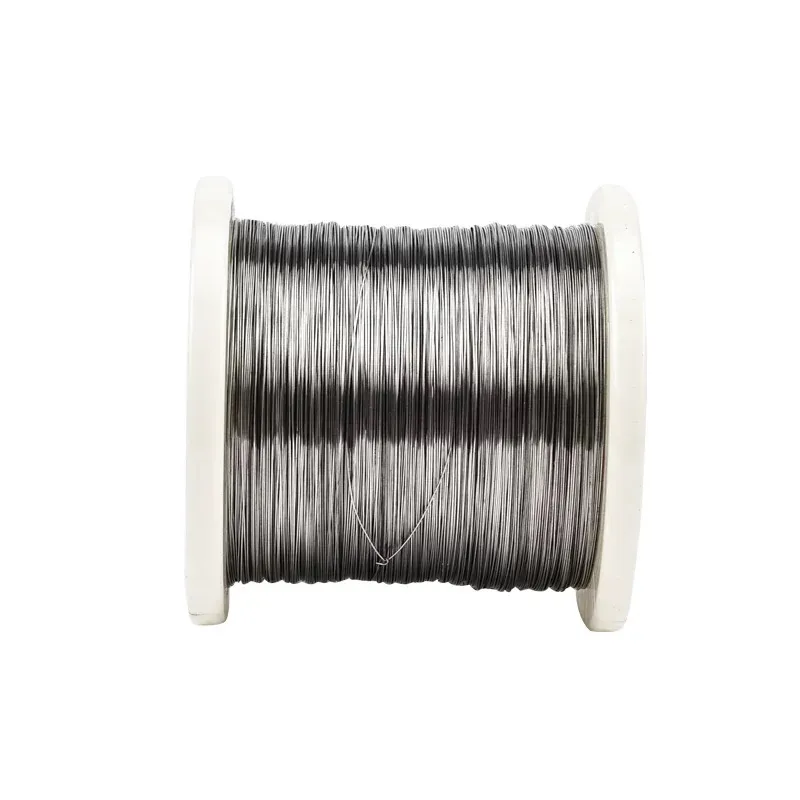
FeCrAl Vs Nickel-Chromium Resistance Wire: Which Is Better For Your Heating Elements?
Jul 10, 2026

When selecting resistance wire for heating elements, engineers face a critical decision: FeCrAl (iron-chromium-aluminum) or Nickel-Chromium (NiCr)? Both are the most widely used resistance heating alloys in the world, but they differ significantly in composition, performance, cost, and suitability for specific applications. This guide provides a detailed, data-driven comparison to help you make the right choice.
What Is FeCrAl Resistance Wire?
FeCrAl (Iron-Chromium-Aluminum) alloys are ferritic resistance heating materials that use iron as the base metal, with chromium and aluminum as primary alloying elements. The most common grade is 0Cr25Al5 (equivalent to Kanthal A-1), which contains approximately 25% chromium and 5% aluminum.
FeCrAl alloys form a dense aluminum oxide (Al2O3) surface layer when heated, which provides exceptional oxidation resistance at temperatures up to 1250°C. This protective layer is self-healing - if damaged, it reforms automatically in oxidizing atmospheres, ensuring long service life.
Key characteristics of FeCrAl include high resistivity (1.42 μΩ·m at 20°C), low density (7.10 g/cm3), and excellent sulfur resistance, making it particularly suitable for industrial furnaces and high-temperature applications where cost efficiency matters.
What Is Nickel-Chromium Resistance Wire?
Nickel-Chromium (NiCr) alloys are austenitic resistance heating materials with nickel as the base metal and chromium as the primary alloying element. The most widely used grade is Cr20Ni80 (also known as Nichrome 80/20 or Ni80Cr20), containing approximately 20% chromium and 80% nickel.
NiCr alloys form a chromium oxide (Cr2O3) protective layer at high temperatures, providing good oxidation resistance up to 1200°C. Unlike FeCrAl, NiCr maintains excellent ductility after prolonged high-temperature service, making it easier to shape, repair, and weld.
NiCr is characterized by superior mechanical stability, non-magnetic properties, and outstanding corrosion resistance in various atmospheres. Its resistivity is 1.09 μΩ·m at 20°C, with a density of 8.2 g/cm3.
Chemical Composition Comparison
The fundamental difference between these two alloys lies in their chemical composition, which directly determines their performance characteristics.
| Element | FeCrAl (0Cr25Al5) | NiCr (Cr20Ni80) |
|---|---|---|
| Cr (Chromium) | 23.0–26.0% | 20.0–23.0% |
| Al (Aluminum) | 4.5–6.5% | ≤0.50% |
| Ni (Nickel) | ≤0.60% | Remainder (~77–80%) |
| Fe (Iron) | Remainder (~70%) | ≤1.0% |
| C (Carbon) | ≤0.06% | ≤0.08% |
| Si (Silicon) | ≤0.60% | 0.75–1.60% |
| Mn (Manganese) | ≤0.70% | ≤0.60% |
| S (Sulfur) | ≤0.025% | ≤0.015% |
| P (Phosphorus) | ≤0.025% | ≤0.020% |
Data source: GB/T 1234 (High Resistance Electric Heating Alloy standard)
The key distinction: FeCrAl is iron-based with no nickel content, while NiCr is nickel-based with minimal iron. This composition difference drives the cost gap - nickel is a significantly more expensive raw material than iron.
Key Properties Comparison
| Property | FeCrAl (0Cr25Al5) | NiCr (Cr20Ni80) |
|---|---|---|
| Max Operating Temperature | 1250°C | 1200°C |
| Resistivity (20°C) | 1.42 μΩ·m | 1.09 μΩ·m |
| Density | 7.10 g/cm3 | 8.2 g/cm3 |
| Melting Point | ~1500°C | ~1400°C |
| Tensile Strength | 630–780 MPa | ≥650 MPa |
| Elongation | ≥12% | ≥20% |
| Magnetic Property | Magnetic | Non-magnetic |
| Thermal Conductivity | 12.8 W/(m·K) | 15 W/(m·K) |
| Coefficient of Thermal Expansion | 16.0 × 10⁻⁶/°C | 14.0 × 10⁻⁶/°C |
Several critical differences emerge from this data:
Resistivity: FeCrAl's resistivity (1.42 μΩ·m) is approximately 30% higher than NiCr's (1.09 μΩ·m). This means for the same resistance value, FeCrAl wire can be shorter and thicker, reducing material usage and simplifying element design.
Density: FeCrAl is 13.4% lighter than NiCr (7.10 vs 8.2 g/cm3). Combined with higher resistivity, a FeCrAl heating element weighs significantly less than a NiCr element of equivalent power output - typically requiring 20–30% less material by weight.
Temperature: FeCrAl can operate at temperatures 50°C higher than NiCr (1250°C vs 1200°C), making it the preferred choice for demanding high-temperature furnace applications.
Advantages and Disadvantages
FeCrAl (0Cr25Al5) - Pros and Cons
Advantages:
- Higher maximum operating temperature (1250°C)
- Higher resistivity means less material needed
- Lower density reduces overall weight and cost
- Excellent sulfur and corrosion resistance in reducing atmospheres
- No nickel content - significantly lower raw material cost
- Longer service life at temperatures above 1000°C due to stable Al2O3 oxide layer
Disadvantages:
- Lower ductility after high-temperature use - becomes brittle
- Poorer welding performance compared to NiCr
- Magnetic, which may be undesirable in certain applications
- Higher tendency to deform at elevated temperatures due to lower hot strength
- Sensitive to nitrogen-containing atmospheres, which can cause embrittlement
NiCr (Cr20Ni80) - Pros and Cons
Advantages:
- Excellent ductility and formability - easy to shape, coil, and repair
- Superior welding performance
- Non-magnetic
- Better high-temperature mechanical strength and shape stability
- Excellent oxidation resistance in various atmospheres
- More stable resistance-temperature curve - minimal drift over time
Disadvantages:
- Contains 80% nickel - significantly more expensive
- Lower maximum operating temperature (1200°C)
- Lower resistivity requires more material for the same resistance
- Higher density increases weight and shipping costs
- Susceptible to sulfur attack in reducing atmospheres containing sulfur compounds
Applications: When to Choose Which
Choose FeCrAl When:
- Industrial furnaces operating at 1000–1250°C
- Household appliances such as electric ovens, toaster ovens, and ceramic heaters where cost optimization is critical
- Sulfur-containing environments where NiCr would corrode rapidly
- High-volume production where the 20–30% material savings significantly reduces per-unit cost
- Infrared heating panels and radiant heaters requiring stable high-temperature performance
Choose NiCr When:
- Precision heating applications requiring tight resistance tolerance and long-term stability
- Applications requiring frequent reshaping or repair of heating elements
- Welded assemblies where superior weldability is essential
- Non-magnetic environments such as certain laboratory or electronic equipment
- Cartridge heaters, tubular heaters, and mica band heaters where formability and ductility are prioritized
- Atmospheres containing moisture or oxidizing gases where NiCr's Cr2O3 layer performs reliably
How to Choose the Right Resistance Wire for Your Project
Consider these four decision factors:
- Operating Temperature: If your application exceeds 1200°C, FeCrAl is the only viable option. Below 1000°C, both alloys perform well.
- Budget Sensitivity: FeCrAl typically costs 30–50% less than NiCr per meter of equivalent resistance wire, due to the absence of nickel. For high-volume orders, this difference is substantial.
- Mechanical Requirements: If the heating element must be formed into complex shapes, welded, or may need field repair, NiCr's superior ductility (≥20% elongation vs ≥12%) makes it the safer choice.
- Atmosphere Conditions: In sulfur-containing or reducing atmospheres, FeCrAl outperforms NiCr. In moist or oxidizing environments, NiCr offers better long-term stability.
About Aoyuan Alloy Material Co., Ltd
As a specialized manufacturer of resistance heating alloys based in Xinghua, Jiangsu, China, Taizhou Aoyuan Alloy Material Co., Ltd supplies both FeCrAl and NiCr resistance wire in diameters from 0.07mm to 9.0mm. Our products comply with GB/T 1234 and international standards, with full chemical composition certificates provided for every batch. Custom specifications, surface treatments, and packaging are available upon request. Contact us for a quote within 24 hours.
Summary
Both FeCrAl and NiCr resistance wires have distinct advantages. FeCrAl (0Cr25Al5) excels in high-temperature, cost-sensitive applications with its superior resistivity, lighter weight, and lower material cost. NiCr (Cr20Ni80) remains the top choice for applications demanding excellent formability, weldability, and mechanical stability at moderate temperatures.
The decision ultimately comes down to your specific operating conditions, budget, and mechanical requirements. For most industrial furnace applications above 1000°C, FeCrAl delivers the best value. For precision appliances and welded assemblies below 1000°C, NiCr provides unmatched reliability.
FAQ
Q1: Which lasts longer, FeCrAl or NiCr?
At temperatures above 1000°C, FeCrAl typically has a longer service life due to its more stable Al2O3 oxide layer. Below 900°C, both alloys offer comparable longevity, though NiCr maintains better mechanical properties over time.
Q2: Can I replace NiCr wire with FeCrAl wire in an existing heater?
Yes, but you must recalculate the wire gauge and length. Because FeCrAl has higher resistivity (1.42 vs 1.09 μΩ·m), a shorter or thicker wire is needed to achieve the same resistance. Consult with our engineering team for substitution calculations.
Q3: Is FeCrAl magnetic?
Yes, FeCrAl (0Cr25Al5) is magnetic due to its ferritic microstructure. NiCr (Cr20Ni80) is non-magnetic. This may matter in applications sensitive to magnetic interference.
Q4: What diameter range is available?
Both FeCrAl and NiCr resistance wire are available in diameters from 0.07mm to 9.0mm. Custom sizes and ribbon/strip forms can be manufactured to specification.
Q5: How do I order customized resistance wire?
Provide your required alloy grade, diameter, quantity, and any special requirements (surface treatment, insulation, spooling) through our Request a Quote page. We respond within 24 hours with pricing and lead time.